

If your typing speed has stopped improving, the problem may not be a lack of practice.
Sometimes, the way you practice is what holds you back.
You can take dozens of typing tests every day and still repeat the same habits that cause hesitation, mistakes, and inconsistent WPM scores.
Typing faster is not simply about pressing keys more aggressively. Efficient typing depends on:
accuracy, rhythm, finger control, keyboard familiarity, and consistency.
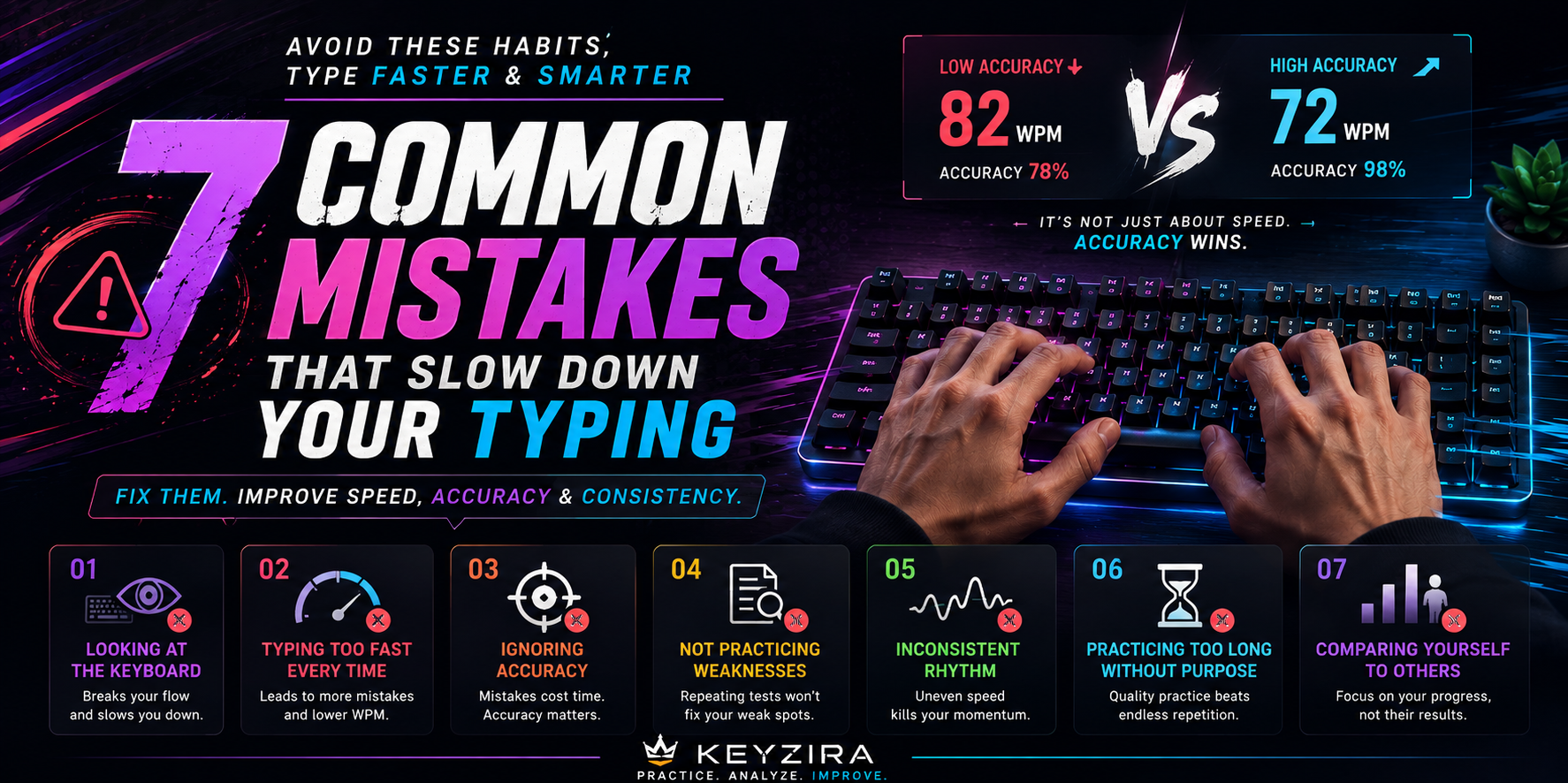
Here are seven common mistakes that can slow down your typing—and what you can do about them.
1. Trying to type as fast as possible on every test
A typing test can quickly turn into a personal-record competition.
You see your best score at 82 WPM and start every new test thinking:
“I need to beat 82.”
That can cause you to type faster than your current level of control allows.
The result may be:
- more incorrect letters,
- frequent Backspace use,
- broken rhythm,
- lower accuracy,
- frustration when the final score drops.
A better approach is to separate practice sessions from personal-record attempts.
During practice, use a speed that allows you to stay in control.
For example, if your maximum speed is around 75 WPM but your accuracy falls heavily at that pace, spend some time working around:
60–68 WPM with strong accuracy.
Once that speed becomes easy, increase it gradually.
Your personal best should be the result of improvement—not the only goal of every session.
2. Looking at the keyboard too often
Looking down at the keyboard may seem harmless because it helps you find difficult keys.
But every time your eyes move away from the screen, your typing flow is interrupted.
The process becomes:
look at screen → look at keyboard → find key → look back at screen
instead of one continuous movement.
If you are trying to learn touch typing, start reducing how often you look down.
You do not need to stop completely on day one.
Begin with familiar sections of the keyboard.
Try writing common words without looking, and only check the keyboard when you are genuinely lost.
Over time, your fingers begin to remember key positions automatically.
The less visual searching you need, the easier it becomes to maintain a stable rhythm.
3. Ignoring accuracy because WPM looks more impressive
A large WPM number is satisfying.
But speed without accuracy can create the illusion of progress.
Consider these two results:
Typist A: 83 WPM — 89% accuracy
Typist B: 72 WPM — 98% accuracy
Typist A technically typed faster during the test.
But in real writing, repeated corrections can waste time.
A mistake often means:
stop → Backspace → correct → recover your rhythm
If this happens repeatedly, your effective typing speed falls.
When practicing, try to maintain accuracy in a comfortable range before increasing your pace.
You want your speed and control to improve together.
4. Repeating typing tests instead of practicing your weaknesses
Typing tests are excellent for measuring performance.
But a test is not always the best way to fix a specific weakness.
Suppose every test shows mistakes in words such as:
- definitely
- rhythm
- necessary
- different
- consistency
If you simply start another random test, those difficult patterns may only appear occasionally.
Instead, isolate them.
Practice the exact words or letter combinations that cause trouble.
Maybe the issue is not the full word. It could be a transition like:
ff
th
tion
ry
ent
Targeted practice gives your fingers more repetitions of the movements that actually need improvement.
Keyzira's Personal Training mode can help you focus on words and characters that repeatedly cause errors.
5. Using an inconsistent rhythm
Fast typing often looks smooth.
That is not an accident.
Experienced typists usually maintain a relatively consistent rhythm instead of constantly switching between extreme speeds.
A common beginner pattern looks like this:
easy word → very fast
difficult word → complete stop
easy word → very fast again
mistake → panic
next word → rush
Your average WPM may look reasonable, but the typing experience feels unstable.
Instead, try to find a pace you can maintain through both easy and difficult parts of the text.
You may initially type slightly slower.
That is fine.
A stable:
65 WPM
can eventually become easier to increase than an unstable session jumping between 40 and 90 WPM.
Think of typing speed as a rhythm rather than a series of sprints.
6. Practicing for too long without a purpose
More practice does not automatically mean better practice.
After a long typing session, you may become:
- mentally tired,
- less accurate,
- careless with finger placement,
- focused only on finishing tests.
At that point, you may simply be repeating poor movements.
For many people, a short structured session can be more useful than an hour of random testing.
For example:
3 minutes: warm-up
4 minutes: standard typing test
4 minutes: difficult words
2 minutes: higher-speed practice
2 minutes: final test
That is only 15 minutes, but every section has a purpose.
Quality and consistency matter more than simply increasing the number of tests you complete.
7. Comparing every score with other people
Leaderboards can be motivating.
Seeing someone type at 120 WPM might make you want to improve.
But constantly comparing your performance with advanced typists can also make your own progress feel insignificant.
Suppose you started at:
32 WPM
and now consistently type:
47 WPM.
That is meaningful improvement even if another player types 100+ WPM.
Your most useful comparison is:
you today vs. you a few weeks ago.
Track:
- average WPM,
- accuracy,
- personal best,
- difficult words,
- performance in longer tests.
A single leaderboard position does not tell you whether your technique is actually improving.
Bonus mistake: Changing your technique every few days
Typing improvement takes repetition.
If you constantly change:
- finger placement,
- keyboard layout,
- practice method,
- typing posture,
- test duration,
it becomes difficult to build consistent muscle memory.
That does not mean you should never adjust your technique.
If something is clearly inefficient or uncomfortable, change it.
But give a reasonable method enough time before deciding it does not work.
Typing is a motor skill. Repetition matters.
Why does typing faster sometimes make you slower?
This sounds contradictory, but it happens frequently.
When you push far beyond your comfortable speed:
- errors increase,
- you use Backspace more,
- your rhythm breaks,
- concentration drops,
- your final WPM suffers.
For example, you might be comfortable at:
65 WPM / 98% accuracy
but try to force:
85 WPM.
You may finish with:
68 WPM / 90% accuracy
after all the corrections.
You worked harder but gained almost nothing.
A slightly challenging pace is usually more useful than maximum speed on every attempt.
How do you know which mistake is affecting you?
Look at your test history.
Your WPM is high but accuracy is consistently low
You may be pushing speed too aggressively.
Your first few seconds are fast but your score falls over time
Your rhythm or endurance may need work.
You repeatedly miss the same words
You need targeted practice.
You often stop completely before certain letters
Your keyboard familiarity may need improvement.
Your results change dramatically between tests
You may be relying too much on short bursts of speed instead of a sustainable pace.
Your results can reveal more than just whether you are “fast” or “slow.”
A better practice cycle
Instead of repeatedly taking tests, try this:
Step 1 — Test
Take one standard test.
Step 2 — Review
Look at your WPM, accuracy, and mistakes.
Step 3 — Practice
Work specifically on what caused problems.
Step 4 — Test again
Repeat the same test duration and compare the result.
This gives every test a purpose.
Should you always type slowly while practicing?
No.
You need some higher-speed practice to improve your maximum pace.
But the key word is controlled.
A useful practice session can include both:
accuracy-focused typing
and:
short high-speed attempts.
For example:
5 minutes around your comfortable speed
→ 2 minutes slightly faster
→ return to controlled typing.
This lets you challenge your current limit without spending the entire session making mistakes.
Why consistency matters more than one great score
Imagine these two typists.
Typist A
Scores:
48
81
50
46
77
49
Typist B
Scores:
65
66
64
67
66
65
Typist A has the higher personal best.
But Typist B has much more predictable performance.
For everyday writing, that consistency can be extremely valuable.
The goal is not only to reach a high WPM once.
It is to make your faster speed repeatable.
How long should you practice?
There is no perfect duration for everyone.
For many users, 10–20 minutes of focused practice is enough for a useful session.
If you want to practice longer, take breaks.
Once your hands become uncomfortable or your concentration noticeably drops, continuing may not produce useful training.
Good typing practice should feel focused—not exhausting.
Final thoughts
If your typing speed is not improving, do not immediately assume you need more practice.
First check whether you are making one of these seven mistakes:
- Chasing maximum speed on every test
- Looking at the keyboard too often
- Ignoring accuracy
- Taking tests instead of practicing weaknesses
- Typing with an inconsistent rhythm
- Practicing too long without a clear goal
- Comparing yourself too much with other typists
Fixing even one of these habits can make your existing practice more effective.
The goal is not simply to move your fingers faster.
It is to become:
faster, more accurate, smoother, and more consistent.
With Keyzira, you can use the Typing Speed Test to measure your performance, Personal Training to work on repeated mistakes, and Statistics to see whether your normal typing level is improving over time.