

Have you ever finished a typing test, looked at your WPM score, and wondered how much faster a human can actually type?
Reaching 60, 80, or even 100 words per minute can already feel incredibly fast. But some of the fastest typists in history have gone far beyond those numbers, reaching speeds of more than 200 WPM.
So, what is the fastest typing speed ever recorded? The answer is more complicated than simply looking at the highest number. Typing records have been set on different keyboards, over different test lengths, and under very different conditions.
Let's take a look at some of the most remarkable typing speeds ever recorded and what they can teach us about becoming faster typists.
What Is the Fastest Typing Speed Ever Recorded?
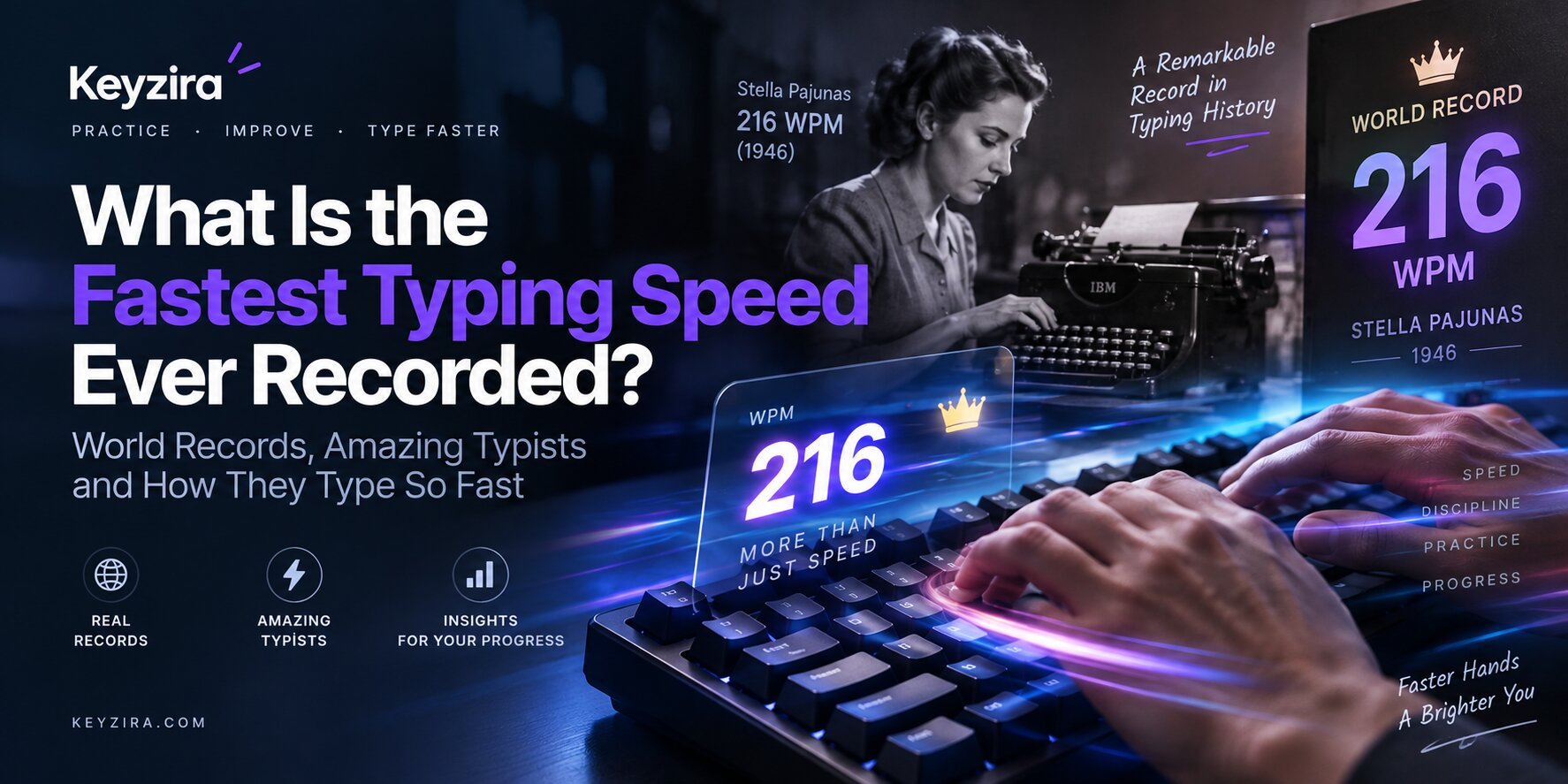
One of the most remarkable officially documented typing performances belongs to Stella Pajunas.
In 1946, Pajunas typed an incredible 216 words per minute during a one-minute official test on an IBM electric typewriter in Chicago.
To put that into perspective, 216 WPM means typing approximately 3.6 words every second.
That level of speed requires much more than simply moving your fingers quickly. It requires exceptional accuracy, rhythm, muscle memory, and familiarity with the keyboard.
Even decades later, Pajunas' performance remains one of the most famous achievements in typing history.
Who Was Barbara Blackburn?
Another name that frequently appears when discussing the world's fastest typists is Barbara Blackburn.
Blackburn became famous for her extraordinary typing ability using the Dvorak keyboard layout rather than the traditional QWERTY layout.
She was historically listed by Guinness with the ability to reach approximately 170 WPM and maintain around 150 WPM for 50 minutes.
A peak speed of 212 WPM has also been widely associated with Blackburn. However, this figure should be treated differently from a controlled one-minute record because it was reported as a brief peak rather than a directly comparable standardized test.
What makes Blackburn particularly impressive is not only her maximum speed, but her ability to maintain extremely high typing speeds for long periods.
Typing quickly for a few seconds is one thing.
Typing at around 150 WPM for nearly an hour is something completely different.
Can People Type Faster Than 200 WPM Today?
Yes.
Modern competitive typing platforms have made it possible for highly skilled typists to achieve speeds above 200 WPM, especially during short tests.
Some online results even approach or exceed 300 WPM during very short bursts.
However, these numbers should not automatically be compared with historical typing records.
A 15-second online typing test and a one-minute official typewriter test measure different things. The text used, keyboard hardware, test duration, accuracy requirements and scoring system can all influence the final WPM result.
This is why asking who the "fastest typist ever" does not always have one simple answer.
Why Do Typing Records Vary So Much?
Typing speed sounds like a simple measurement, but several factors can dramatically affect a result.
Test Duration
A person may be able to type extremely quickly for 15 seconds but struggle to maintain the same speed for five minutes.
Short tests often produce higher peak WPM scores because the typist does not need to maintain the pace for very long.
Longer tests measure consistency and endurance in addition to raw speed.
Text Difficulty
Typing common words such as:
the – and – you – that – have
is usually easier than typing unusual vocabulary, numbers, punctuation marks, or complex sentences.
Two people can therefore complete different typing tests and receive different WPM scores even if their actual skill levels are similar.
Accuracy
Speed without accuracy can be misleading.
Imagine two typists:
Typist A: 120 WPM with 99% accuracy
Typist B: 135 WPM with 88% accuracy
Typist B may have the higher raw speed, but the large number of mistakes can make the result less useful in real-world writing.
For this reason, typing performance should usually be evaluated using both WPM and accuracy.
Keyboard Layout
Keyboard layout can also influence typing technique.
Most people today use QWERTY, while some high-speed typists have used alternative layouts such as Dvorak.
Barbara Blackburn, for example, became famous for typing on a Dvorak keyboard.
Different layouts place commonly used letters in different positions, potentially changing how far the fingers need to move while typing.
What Does WPM Actually Mean?
WPM stands for Words Per Minute and is the most common measurement used in typing tests.
However, a "word" in a typing test does not necessarily mean a normal dictionary word.
Many typing systems calculate one standardized word as approximately five characters, including spaces.
This makes it possible to compare typing performance across different texts.
For example, if you type a large amount of text within 60 seconds, the number of characters can be converted into an estimated WPM score.
That gives you a simple measurement you can use to track your typing progress over time.
Is 100 WPM Considered Fast?
Yes. Reaching 100 WPM is already an impressive typing speed for most people.
You do not need to approach world-record speeds to be considered a fast typist.
Typing comfortably at a high speed while maintaining strong accuracy can be much more useful than reaching an extreme WPM score for only a few seconds.
If you currently type at 40 or 50 WPM, reaching 60 WPM consistently is meaningful progress.
If you already type at 80 WPM, reaching 90 or 100 WPM while maintaining accuracy can be a challenging next goal.
The best benchmark is often your own previous performance.
How Do the Fastest Typists Get So Fast?
There is no single trick that instantly turns someone into a 150+ WPM typist.
Extremely fast typing usually develops from several skills working together.
Muscle Memory
Fast typists do not consciously search for every letter.
After enough practice, their fingers automatically move toward the correct keys. This reduces the amount of thinking required for each individual keystroke.
Looking Ahead
Advanced typists often process upcoming letters and words while their fingers are still typing the current ones.
Instead of thinking:
letter → letter → letter
typing begins to feel more like a continuous sequence of movements.
Consistent Rhythm
Speed is not only about moving your fingers as quickly as possible.
A consistent typing rhythm can be more effective than repeatedly accelerating and slowing down.
Smooth movement reduces hesitation between words and helps maintain speed over longer tests.
Accuracy
The fastest typists are usually highly accurate as well.
Constantly pressing Backspace interrupts rhythm and adds extra keystrokes.
Improving accuracy can therefore help improve effective typing speed even without physically moving your fingers faster.
Practice
Muscle memory develops through repetition.
Regular typing practice helps your brain associate letters and words with specific finger movements until those movements become increasingly automatic.
Should You Try to Reach 200 WPM?
For most people, probably not.
World-record typing speeds are fascinating, but they are extreme performances rather than realistic requirements for everyday computer use.
A better goal is to gradually improve your own combination of:
Speed + Accuracy + Consistency
If you currently type at 45 WPM, aim for 50.
Once 50 WPM becomes comfortable, work toward 60.
Instead of immediately chasing 150 or 200 WPM, building speed gradually can help you maintain better technique and accuracy.
Test Your Own Typing Speed
You may not type at 216 WPM like Stella Pajunas, but every fast typist started somewhere.
The easiest way to understand your current level is to measure it.
Take a Typing Speed Test and record your WPM and accuracy. After practicing consistently for a few weeks, take the test again and compare your results.
Pay attention to more than your highest score.
Look for improvements in:
- WPM
- Accuracy
- Consistency
- Difficult letters
- Typing rhythm
A personal best is exciting, but being able to repeatedly type near that speed is an even better sign of progress.
Final Thoughts
The history of typing shows just how fast human fingers can become with exceptional technique and practice.
Stella Pajunas' 216 WPM performance in 1946 remains one of the most remarkable officially documented typing achievements, while Barbara Blackburn became famous for combining exceptional speed with impressive endurance.
Modern online typists can achieve even higher numbers during short tests, but comparing those results directly with historical records can be difficult because test conditions have changed dramatically.
Fortunately, you don't need a world record to become a great typist.
Focus on improving your accuracy, building muscle memory, maintaining a consistent rhythm, and gradually increasing your WPM.
Then see how fast your fingers can really go.
Ready to find out? Take the Keyzira Typing Speed Test and discover your current WPM.