

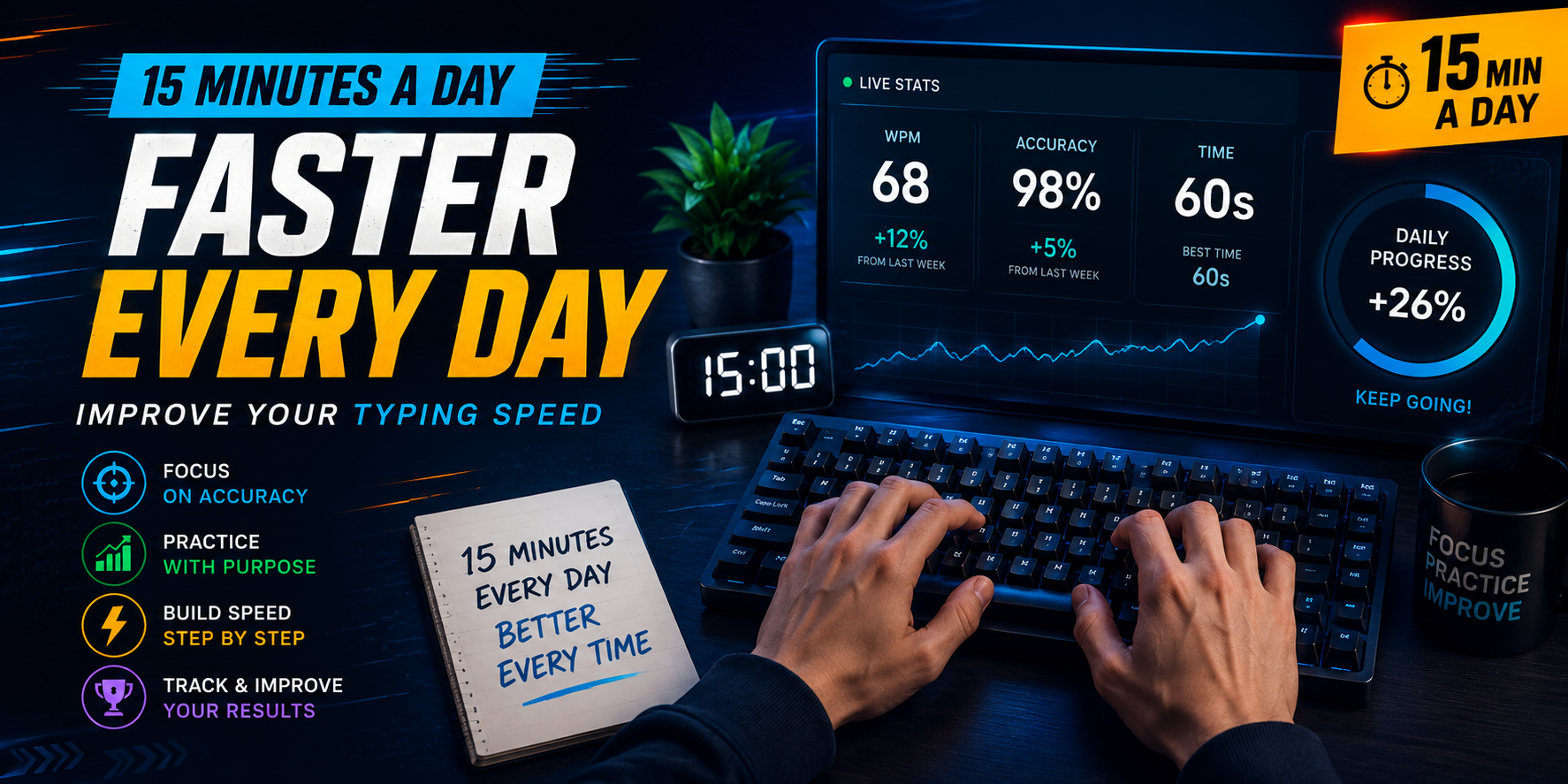
Improving your typing speed does not mean spending hours in front of a keyboard every day.
For many people, a short and focused practice session is easier to maintain and more useful than an occasional long session.
The goal is not simply to press keys faster. Good typing performance combines:
speed, accuracy, rhythm, and consistency.
A simple 15-minute routine can help you work on all four.
Here is a practical daily plan you can follow.
Minutes 0–2: Warm up without chasing speed
Do not start your session by immediately trying to break your WPM record.
Use the first two minutes to write at a comfortable pace.
Focus on:
- relaxed hands,
- light key presses,
- steady rhythm,
- looking at the keyboard less often,
- avoiding unnecessary corrections.
Your WPM during this stage does not matter.
This is a warm-up, not a performance test.
The purpose is to get your fingers moving naturally before increasing the pace.
Minutes 2–6: Take a standard typing test
Once you feel comfortable, take a normal typing speed test.
If you want to track your progress accurately, try to keep the conditions similar each day.
For example:
- use the same language,
- choose the same test duration,
- use the same keyboard,
- avoid switching between very different text types.
A 60-second typing test can be useful for regular progress tracking because it is long enough to measure rhythm without taking much time.
Pay attention to more than your WPM.
Look at:
WPM
How quickly you are typing.
Accuracy
How much of your input is correct.
Mistakes
Which words or letter combinations slow you down.
A higher WPM score is useful, but it is not very valuable if your accuracy drops heavily.
Minutes 6–10: Practice the words you struggle with
This is one of the most important parts of the routine.
After your test, look at the words you typed incorrectly or slowly.
For example, you may repeatedly struggle with words such as:
- accuracy
- improvement
- keyboard
- consistency
- difficult
- practice
Instead of starting another random test immediately, spend a few minutes repeating the difficult patterns.
The purpose is not to memorize individual words.
You are training the finger transitions inside those words.
If you repeatedly struggle with combinations like:
th
ing
tion
ment
working directly on them may be more useful than typing hundreds of unrelated words.
Keyzira's Personal Training mode can be used to focus on words and characters that caused problems in previous tests.
Minutes 10–13: Push slightly above your normal pace
Now increase your speed.
Do not try to type at your absolute maximum.
Instead, aim slightly above your comfortable pace.
For example, if your normal speed is around:
55 WPM
try working around:
60–65 WPM
for a few minutes.
The important part is maintaining reasonable accuracy.
If you suddenly start making mistakes on every line, you are probably pushing too hard.
The best training pace is usually one that feels challenging but still controlled.
Minutes 13–15: Take one final test
Finish the session with another test under the same conditions as the first one.
Compare the results.
Do not only ask:
“Did I break my record?”
Also check:
- Did my accuracy improve?
- Did I make fewer mistakes?
- Did my typing feel smoother?
- Was my WPM more consistent?
- Did difficult words feel easier?
Sometimes your final WPM may stay the same while your accuracy improves.
That is still progress.
The full 15-minute routine
Your daily practice can look like this:
0–2 minutes: Warm-up
2–6 minutes: Standard typing test
6–10 minutes: Difficult words and mistakes
10–13 minutes: Faster controlled practice
13–15 minutes: Final test
Total:
15 minutes
The goal is not to achieve a personal best every day.
The goal is to build a routine that gradually improves your normal typing level.
Why short daily practice can work
Typing is partly a motor skill.
When you are still learning a key location, your brain has to consciously think about the movement.
With repetition, that movement becomes more automatic.
For example, a beginner may think:
“Where is the letter P?”
An experienced typist does not consciously search for it.
The finger moves automatically.
Regular practice helps more movements reach that automatic stage.
This is one reason short daily sessions can be effective: you repeatedly reinforce the same movement patterns without turning every session into an exhausting workout.
Do not sacrifice accuracy for WPM
One of the most common mistakes is trying to increase speed too quickly.
Consider these two results:
75 WPM — 88% accuracy
and:
65 WPM — 98% accuracy
The first score looks faster.
But in real writing, frequent corrections may reduce the advantage.
Every mistake can require you to:
- stop,
- press Backspace,
- correct the word,
- rebuild your rhythm.
That takes time.
Instead of chasing speed at any cost, try to increase your WPM while keeping accuracy high.
Build speed in small steps
If you currently type around 45 WPM, you do not need to aim for 100 WPM immediately.
A more useful progression may look like:
45 → 50 → 55 → 60 WPM
Once a new speed feels comfortable, move to the next target.
Small improvements are easier to measure and usually encourage better technique.
Why your WPM will not improve every day
Typing performance naturally changes.
You may type faster one day and slower the next because of:
- tiredness,
- concentration,
- sleep,
- unfamiliar words,
- keyboard differences,
- stress,
- test duration.
For example:
Monday: 63 WPM
Tuesday: 66 WPM
Wednesday: 59 WPM
Thursday: 65 WPM
Friday: 67 WPM
The 59 WPM result does not necessarily mean you became worse.
Look at the overall pattern rather than one isolated result.
Track averages, not only personal records
A personal record is motivating, but it does not always represent your normal typing ability.
Imagine your best result is:
91 WPM
but your last ten tests are usually between:
67 and 73 WPM.
Your current reliable speed is probably closer to that range than 91 WPM.
Useful metrics to follow include:
- 7-day average WPM,
- average accuracy,
- best WPM,
- number of tests,
- frequently missed words,
- consistency across longer tests.
Keyzira's statistics can help you compare results over time rather than relying on a single high score.
Should you practice every day?
You do not necessarily need to practice seven days a week.
Consistency matters more than forcing yourself to practice when your hands or attention are exhausted.
A reasonable schedule could be:
5–6 short sessions per week
with rest when needed.
If your fingers, wrists, or hands feel uncomfortable, stop and rest.
Typing practice should not require pushing through pain.
Should beginners use the same routine?
Yes, but beginners should place even more emphasis on accuracy.
If you are new to touch typing, your 15 minutes might look like:
5 minutes: correct finger placement
5 minutes: slow controlled typing
3 minutes: difficult letters
2 minutes: short typing test
A beginner typing at 25 WPM with strong technique may build better long-term habits than someone forcing 50 WPM with constant mistakes.
When should you start focusing on speed?
Speed becomes more useful once you can type comfortably without thinking about every key.
If you can maintain:
high accuracy at a comfortable WPM
then gradually increase the pace.
For example:
50 WPM at 98% accuracy
→ try 55 WPM
→ stabilize
→ move toward 60 WPM.
This makes improvement more controlled.
What if you keep making the same mistakes?
Repeating random typing tests may not solve a specific problem.
If the same word or letter combination appears in your mistakes again and again, isolate it.
For example, if you repeatedly type:
becuase
instead of:
because
slow down and repeat the correct movement.
The same applies to difficult letter transitions.
Targeted practice is often more useful than simply adding more test volume.
How long does it take to type faster?
There is no universal timeline.
Your progress depends on:
- current typing level,
- previous habits,
- accuracy,
- practice frequency,
- keyboard familiarity,
- typing technique.
Someone at 25 WPM may gain speed relatively quickly.
Someone already typing 100 WPM may need much more work to gain another 10 WPM.
Compare yourself with your previous results, not only with other typists.
A simple weekly goal
Instead of saying:
“I want to type 120 WPM.”
try setting a smaller target.
For example:
This week: average 58 WPM with 96%+ accuracy
Next week: average 60 WPM with 96%+ accuracy
That gives you something measurable without forcing unrealistic jumps.
Final thoughts
You do not need extremely long practice sessions to improve your typing.
A focused daily routine can be enough:
warm up → test → study mistakes → increase pace → test again.
The most important thing is not producing one impressive score.
It is becoming:
faster, more accurate, and more consistent over time.
With Keyzira, you can measure your WPM and accuracy with the Typing Speed Test, focus on difficult words using Personal Training, and use your statistics to see whether your daily practice is actually improving your performance.