

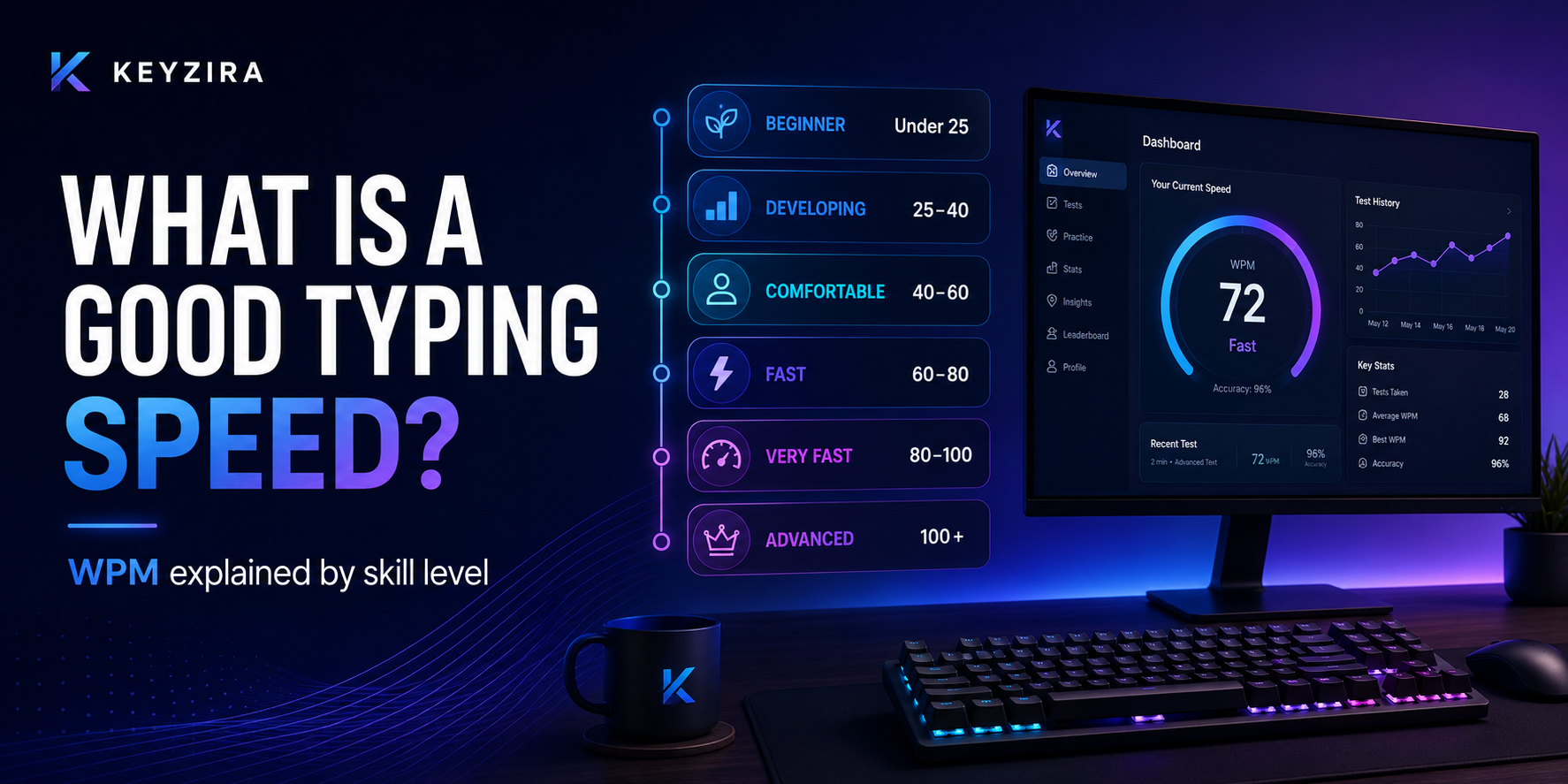
When you finish a typing test and see a score like 42 WPM, 68 WPM, or 105 WPM, one question usually comes next:
Is that actually good?
The answer depends on more than one number.
Your typing speed can be affected by:
- how much typing experience you have,
- the language of the test,
- test duration,
- text difficulty,
- accuracy,
- keyboard familiarity,
- whether you use touch typing.
That means there is no single WPM score that defines a “good typist” for everyone.
Still, practical skill ranges can help you understand where your current typing speed stands.
What does WPM mean?
WPM stands for:
Words Per Minute
It is a standard way to represent typing speed.
Typing tests usually estimate how many standard-sized words you could type in one minute based on the number of characters entered.
So if you finish a test with:
65 WPM
it means your typing pace was roughly equivalent to 65 standard words per minute.
WPM makes it easier to compare different typing sessions.
But it should not be viewed alone.
A score of:
80 WPM with very low accuracy
may be less useful than:
70 WPM with excellent accuracy.
Is 20 WPM a good typing speed?
Around 20 WPM is generally a beginner-level pace.
At this stage, you may still:
- search for keys,
- look down at the keyboard often,
- type using only a few fingers,
- pause between words,
- think about individual key positions.
There is nothing wrong with this.
If you are learning touch typing, your speed can even temporarily drop while you replace old habits with better technique.
For someone at 20 WPM, a useful first goal might be:
25 → 30 → 35 WPM
instead of trying to reach extremely high speeds immediately.
Is 30–40 WPM good?
A typing speed in the 30–40 WPM range can be perfectly usable for normal everyday tasks.
At this level, you may comfortably handle:
- messaging,
- basic emails,
- online searches,
- forms,
- casual writing.
You may still lose time when typing long documents or dealing with unfamiliar words.
If your accuracy is already high, improving from this range often comes from better rhythm and reduced keyboard looking rather than simply forcing your fingers to move faster.
Is 40–60 WPM good?
For many users, 40–60 WPM represents a solid everyday typing level.
Typing at this speed can feel comfortable for:
- schoolwork,
- office communication,
- emails,
- documents,
- regular computer use.
Someone around 50–60 WPM with good accuracy usually does not need to think about every key individually.
This is also where consistency starts to matter more.
For example:
55 WPM once
is less informative than consistently typing:
52–57 WPM
across multiple tests.
Is 60–80 WPM fast?
A consistent speed of 60–80 WPM is a strong typing level for most everyday situations.
At this stage, users often:
- look at the keyboard very little,
- maintain a steady rhythm,
- recover quickly from mistakes,
- type long passages comfortably,
- use more efficient finger movement.
If you are typing around:
70 WPM with 97–99% accuracy
you already have a strong balance between speed and control.
Moving higher often requires more focused practice rather than simply taking more random tests.
Is 80–100 WPM very fast?
Yes, 80–100 WPM is fast compared with typical casual typing.
Typing reliably in this range requires:
- strong keyboard familiarity,
- good rhythm,
- efficient finger movement,
- high concentration,
- good accuracy.
The important word is reliably.
Typing 101 WPM once in a short test is different from maintaining 90+ WPM across several 60-second tests.
That is why your average results are often more useful than your personal record.
Is 100+ WPM considered advanced?
Typing above 100 WPM consistently is an advanced level.
At this point, small improvements become harder.
Someone moving from:
30 to 40 WPM
may improve relatively quickly.
But moving from:
105 to 115 WPM
can require much more refinement.
Advanced typists often work on details such as:
- difficult letter combinations,
- maintaining rhythm,
- reducing unnecessary movement,
- accuracy at high speed,
- consistency across longer tests.
The faster you become, the more a small mistake can interrupt your rhythm.
A practical WPM skill-level guide
A simple way to think about typing speed is:
WPMPractical level Under 25 Beginner 25–40 Developing 40–60 Comfortable everyday typing 60–80Fast 80–100 Very fast 100+AdvancedThese are rough practical ranges, not strict universal categories.
A user's real typing ability also depends heavily on accuracy, consistency, language, and test conditions.
Why accuracy changes how WPM should be interpreted
Imagine two typists.
Typist A
84 WPM
89% accuracy
Typist B
75 WPM
98% accuracy
Typist A has the larger WPM number.
But frequent mistakes may require more corrections during real work.
Typist B may produce usable text more efficiently.
That is why a strong typing score should ideally combine:
high WPM + high accuracy
rather than maximizing one while ignoring the other.
What accuracy should you aim for?
There is no single required percentage, but maintaining accuracy in the mid-to-high 90s is a useful target for many typists.
For example:
65 WPM / 98% accuracy
is a much more controlled result than:
72 WPM / 87% accuracy.
If your accuracy collapses whenever you increase speed, it may be better to slow down slightly and stabilize your technique.
Then increase speed gradually.
Why test duration matters
A 15-second typing test and a 120-second typing test do not measure exactly the same thing.
Short tests make it easier to maintain a very high burst of speed.
Longer tests require more:
- consistency,
- concentration,
- rhythm,
- endurance.
For example, you may reach:
95 WPM in 15 seconds
but average:
78 WPM over 60 seconds.
Neither result is necessarily wrong.
They simply measure slightly different aspects of your typing.
When tracking progress, compare results from the same test duration whenever possible.
Why your language affects your WPM
Typing speed can change between languages.
An English test and a Turkish test may contain different:
- letter frequencies,
- word lengths,
- character combinations,
- special characters.
You may therefore type:
75 WPM in English
and:
67 WPM in Turkish
or the opposite.
Your familiarity with the language also matters.
Someone who reads English frequently may recognize and type common English words more quickly than unfamiliar vocabulary.
Why your WPM changes from test to test
Typing speed is not perfectly stable.
One test might show:
72 WPM
and the next:
66 WPM.
That does not mean your real skill changed in two minutes.
Performance can vary because of:
- difficult words,
- mistakes,
- concentration,
- tiredness,
- stress,
- interruptions,
- keyboard position.
This is why several results are more meaningful than a single score.
Personal best vs average WPM
Your personal best is useful for motivation.
But your average WPM usually gives a better picture of your normal level.
Suppose your scores are:
68
70
72
69
91
71
70
Your personal record is:
91 WPM
but most of your results are around 70.
Calling yourself a consistent 91 WPM typist would therefore be misleading.
Tracking your average helps you see real progress.
What WPM should a beginner aim for?
Beginners should not worry too much about hitting a specific number immediately.
Start by building accuracy and keyboard familiarity.
A reasonable progression might be:
20 → 30 WPM
then
30 → 40 WPM
then
40 → 50 WPM
Trying to jump from 25 WPM straight to 80 WPM may encourage sloppy technique.
Small, controlled improvements are easier to maintain.
What WPM should you aim for for work?
This depends heavily on the job.
For normal office tasks, extremely high typing speeds are rarely necessary.
Being able to type at a comfortable pace with high accuracy may be more valuable than chasing a huge benchmark.
For jobs involving large amounts of text entry, transcription, writing, support, or documentation, higher typing speed can save more time.
But again:
usable speed is more important than flashy speed.
A reliable 65 WPM may be more useful than unstable 90 WPM with constant mistakes.
Does faster typing always mean higher productivity?
Not necessarily.
Typing is only one part of many tasks.
For example, when writing an article, email, or report, you also spend time:
- thinking,
- researching,
- organizing ideas,
- editing.
If you spend 20 seconds deciding what to write, increasing your typing speed from 70 to 80 WPM does not eliminate that thinking time.
So very high WPM is useful, but it does not automatically make someone more productive in every situation.
How can you increase your WPM?
If you want to improve your typing speed, focus on four areas.
1. Accuracy
Reduce repeated mistakes first.
2. Rhythm
Try to maintain a steady pace instead of constantly speeding up and slowing down.
3. Difficult words
Practice words and letter combinations that repeatedly cause errors.
4. Consistency
Use regular short practice sessions rather than relying only on occasional personal-record attempts.
Keyzira's Personal Training mode can help you focus on words and characters you struggle with.
How often should you test your WPM?
You can take typing tests as often as you like, but constantly testing without practicing can become unproductive.
A simple routine might be:
Test → identify mistakes → practice → test again
instead of:
Test → test → test → test
A test measures your current ability.
Practice is what helps change it.
When should you move to the next speed goal?
Suppose you are currently around:
55 WPM / 98% accuracy.
Instead of immediately trying to reach 80 WPM, aim for:
60 WPM / 97–98% accuracy.
Once that becomes comfortable and repeatable, move toward:
65 WPM.
This gives you a clear progression without destroying your accuracy.
Is there a maximum typing speed?
Humans can reach extremely high typing speeds, especially in short competitive tests.
But there is no useful single “maximum WPM” target for everyday typing.
The better question is:
How fast can you type while staying accurate, comfortable, and consistent?
That number is much more useful than chasing the highest score you can produce once.
Final thoughts
So, what is a good typing speed?
For many people:
- 40–60 WPM is comfortable,
- 60–80 WPM is fast,
- 80–100 WPM is very fast,
- 100+ WPM is advanced.
But WPM alone does not tell the full story.
A good typist combines:
speed + accuracy + consistency + control.
Instead of comparing yourself only with other users, compare your current results with your own previous performance.
With Keyzira, you can use the Typing Speed Test to measure WPM and accuracy, follow your progress in Statistics, and gradually build a typing speed you can actually maintain.